
Instructions For Race Directors
Make sure your start, finish, and turn arounds, and mile/km splits are marked accurately. If you have lost your list of the precise locations above please contact the club measurer, Steve Eustis. Typically in 5K races, runners like the quick feedback of km splits, while in longer races mile splits are marked (with 5K intervals marked).
Mark the course with lime (granular lime from local hardware store works great!) arrows and/or cones at all points where runners might go astray. Also mark each mile/kilometer with a lime stripe across the running path and mile marker sign (and cone if enough available). Putting the lime in empty, dry gallon milk jugs makes it easy to pour out. A 50 gallon bag fills 4 gallon jugs.
Arrange for traffic guards at confusing or busy intersections to control traffic and direct runners.
Set up water stations for races of 10K or more and 8K or more if the weather is hot and humid. Have water available at the start and finish of the race. In order to enhance the “play-by-play” description of the race, it is often helpful (not required) to have the water stop workers write down the top three men and women’s bib numbers at the station. Runners like to know more than the final finish order – it is often interesting to see how the top runners rise and fall during the race, especially long races.
Food and beverages: Many local grocery stores are willing to donate supplies to your race. Hannaford’s has been very generous in the past donating cups, Gatorade, and water. They have a form that you fill out at the store. Shaw’s and Healthy Living have also given out gift cards to use for supplies. Gatorade and water are easily recycled and used for a future race if unopened. When asking for donations or purchasing food for post race, look at how many racers and volunteers you typically have and try to purchase accordingly, without over-purchasing. Keep notes on the amount of food and drink you have purchase in the past and note if you ran out or ended up with too much. This can be useful for you the next year or future race directors. Popular post race foods are bagels and fruit (oranges, bananas, apples, watermelon, etc.). 13 mile and greater races often have more choices such as yogurt or cookies.
Get commitments for volunteers four to six weeks before the race. All volunteers must fill out the volunteer waiver form. This can be emailed out in advance and brought with them to the race. Here are the major volunteer positions (NOTE: some people can cover more than one position (i.e. registration and results)):
- Finish line set up
- Registration (4-5)
- Parking
- Finish timers (2)
- Tag tearer
- Wicket holder
- Data Entry/Results computation
- Traffic control (number depends on course)
- Food and drink table
- Mile Split timer
- Water station (at least two per water stop – 3 preferred)
- Greeter (directs runners where to sign up, etc.)
- AED Volunteer (in charge of AED during race)
Set up the registration with at least two large tables. One table will be for the registration forms and race information. Runners are also interested in results from prior years and/or course records. Have at least one map of the course available. Have all runners fill out and sign a registration form. If the race is a GMAA race, put the GMAA banner in a visible location. The second table is where runners turn in their registration and pay for the race. If the race has pre-registration, put that at a third table. A volunteer can direct runners to the appropriate tables.
Have the finish line set up during the registration process. Put the large clock in a visible location. Make a chute and put a lime line on the ground at the finish. The chute should be about 10 feet wide at first and narrow down to 3 feet after about 20 feet. This is to keep the finishers in a single file. Put the refreshment tables nearby. The chute can be made from cones or from the metal base plates and poles with flagging connecting them.
Make an announcement that the race will start in 15 minutes at the appropriate time. Get the runners to the starting line at least five minutes before the race so race instructions can be given out. Describe the course, direction markings, splits, aid stations, and anything else they should be aware of on the course.
Important: Give the runners clear instructions on how the finish line will work. Runners will either have their bib tear tag torn, or be given a popsicle stick after crossing the finish line. Popsicle sticks need to be turned in to the recorder as soon as possible after catching their breath and they’ll give their name and age to the recording official. Remind runners they are not allowed to wear headphones, use a baby jogger, or run with a pet in the race (and insurance doesn’t allow it!)
Start the race on time! Mental and physical warm-up can be messed up by a five or ten minute delay as well as frustrate runners.
Bib Numbers Finish Line Techique (for Large Fields or Short Races – Most GMAA Races):
The GMAA will order bib numbers for your race and they are stored with the race kit.
Pre-registration should be encouraged since any pre-registered runners can have all their bib information filled out ahead of time. On the tear tag write in ball point pen the runners name, town, gender and age. Remember to write the bib number on the registration form!
On race day there should be at least three people writing out the bib information. This way there should not be a back up. A separate table or volunteer should be designated to give out the pre-registered runner’s bibs.
One volunteer will be needed for data entry. For a short race data entry should be done as people register. For long races, it can be done after the start of the race. Data entry of pre-registered runners is handled by Tom Chadwick. Tom will e-mail the excel spreadsheet with pre-registration entered one day before the race.
As runners cross the finish line: Race volunteers working the finish line will collect the tear-off tags onto a wicket. They should be instructed in how to put the tags on the wicket so that the order is consistent wicket-to-wicket and race-to-race.
From time to time, the wicket should be handed off to the race volunteer responsible for data entry and a new one started. For instance, a good time to hand off the first wicket is when approximately half the field has finished or, as soon as it becomes full.
The bib number will then be entered, in order of finish, into the spreadsheet.
As soon any number of bibs have been entered into the spreadsheet, place-based age-group results can be generated on-the-fly within the spreadsheet. It is not necessary for finish times to be entered into the spreadsheet in order to generate the age-group results.
After the last runner has crossed the finish line: Both timer tapes should be handed off to the race volunteer responsible for data entry. They will then transcribe the times into the spreadsheet. Note that typically one of the timers will have been designated the primary timer and the other timer as the back up. The tape from the primary timer will be the one entered into the spreadsheet. Timers should note any problems with a pen on the timer tape (a missed runner, double counted runner, bandit, etc.) NOTE: If the timer tape jams up, the times are all saved inside the timer so there is no need for panic. Contact Steve Eustis or Tom Chadwick on how to retrieve the stored times.
At this point, assuming there have been no glitches with a timer, or with the collection of the bib tags, the results are complete. If desired and feasible, the age-group results can be regenerated, printed, posted, etc. on-site.
After returning home from the race-site, the race volunteer responsible for data entry should email the results excel spreadsheet to Tom Chadwick.
Simple Timing/at the Finish (Small Field or Long Race):
- MILE SPLIT TIMER: Start one or two watches at the starting line and ride ahead in a car or bike to the mile mark. Call out times loud and clear for all runners as they pass.
- FINISH TIMERS: Start the two printer-timers and large clock at the beginning of the race. The clock should be in a visible place for all finishers to see. As each person comes across the finish, timers should hit the lap button on their timer. The printer-timer will record the time and place of each finisher.
- POPSICLE STICK DISTRIBUTOR: Get the sticks from the race kit and verify that they are in the correct order. Hand one to each runner in order of finish. Be sure every runner gets one. (instead of Tag Tearer volunteer)
- NAME AND DIVISION RECORDER: Collect the popsicle sticks form the runners and record their first and last name legibly on the results sheet. Record each runner’s division by putting a large circle in the box in correct column. (A number will be written in the circle later so make sure the circle is big enough for two digits.) Be sure each sheet is complete and number before going on the next sheet. Stand or sit in a conspicuous location near the finish line. Call out for any missing numbers. Don’t let the runners wander off with their sticks. A second person can do a second sheet to help alleviate any backups when the middle of the pack comes through. (instead of the Wicket Holder volunteer)
- RESULTS COMPUTATION: Take each finish sheet as it is completed by the recorder. Go down each column by age group and write in circle what place each runner finished. When available (as the number of finishers slows or at the end), get the times from the finish line timers and write them next to each name on the finish sheets. When finished, provide to the race director for awards. It is good to summarize the top runners in each age category on a sparate sheet of paper so the awards ceremony goes smoothly.
General Info for Race Director:
Be sure there is plenty of water for the runners after the race. Provide other refreshments (bagels, bananas, apples, oranges, cider, sports drink, etc.) as possible. Prior to the race your only job should be to mark the course and make sure all the facilities are open. During the race your only job should be to get the race started and give out the awards. Otherwise you should be supervising your volunteers. You should not run in the race. Some of your staff may have questions or need help. Be prepared for things to get hectic when the middle of the pack finishes.
Conduct your awards ceremony as soon as possible after the last runner finishes. (Following these instructions will help you meet that goal.) Make sure you thank volunteers and any sponsors. Also mention the GMAA and encourage people to join the club. Announce that the results will be on the GMAA web site at WWW.GMAA.NET within two days of the race.
FINAL RACE CHECKLIST:
- Create a time line of all activities for the race and when they need to be done (including a section for the 2-3 days before the race)
- Make any facilities arrangements (schools, etc.)
- Get awards and refreshments lined up
- Get change from bank 1 dollar bills and 5 dollar bills
- Determine how awards will be distributed
- (for non-GMAA races) Prepare a race flyer or pre-registration form, put information on web and in paper
- Arrange for volunteer help
- Pick up GMAA race kit Thursday or Friday before race and go over equipment
- Arrive at race early enough to finish marking the course before registration starts
- Enjoy the race!
- After the race return race kit Monday or Tuesday, fill out financial form, turn in results
Race Policies
Race management
- The GMAA’s goal is to put on affordable, high quality running events.
- Please follow these rules as well as Instructions for Race Directors to help insure your race will meet the GMAA quality standards.
- The race can be directed by more than one person, however there should be one contact person who interfaces with the GMAA board. All race directors and race committee members should be GMAA members.
- The race director or co-race director shall attend the annual GMAA Race Director’s meeting each March.
Publicity
- All GMAA races are sponsored by the GMAA. Your race shall use GMAA in the name just like Key Bank in the Key Bank Vermont City Marathon.
- When possible specify which “annual” the race is, for example “33rd annual GMAA Archie Post 5 Miler.
- The race has a club e-mail (such as archiepost@gmaa.net). It is forwarded to the general GMAA mailbox for answering the basic questions; more complex questions will be sent to the race director.
- The race will be advertised on many web pages, the Burlington Free Press and Vermont Sports Today by the publicity officer, . If you see a running web site that does not have your race listed, let us know!
Financials
- All checks should be made to the GMAA.
- After the race a financial balance sheet shall be prepared for the club treasurer specifying incomes, expenses, and new members.
- All GMAA members shall be given a $1 discount on the race fee. No proof is needed. This works on the honor system. Note: GMAA incentive winners are given a $5 discount on the race fee.
- If money is needed prior to race day contact the treasurer for an advance.
- Big ticket items (like t-shirts and porta-lets) can be billed directly to the club treasurer (use the club PO Box).
- All race day revenues/profits will be given to the GMAA immediately after a race. Financial data will be turned in to the treasurer when the race kit is dropped off. The GMAA will cover any losses.
- Races should not plan to donate to charities. If a need exists, the GMAA board may decide to make a donation. Races that are pre approved to give some money to charity are Clarence DeMar and the Turkey Trot. The GMAA treasurer will write the donation check, not the race director. Charity donations require a receipt.
- Race fees are set to keep the race “affordable”. Races should try to make a profit, but not an excessive one. The race fees are reviewed at the end of each year by the GMAA board. If you, as a race director, feel the price should increase, please communicate that with the GMAA board in your post race write-up.
- The race director shall not reimburse themselves from the cash revenues of a race. All revenues (cash and check) should be turned in to the treasurer. The GMAA treasurer will reimburse the race director for out of pocket expenses.
- Receipts – get ’em, keep ’em and submit ’em! Photocopies of receipts are okay.
Sponsorship
- the GMAA has adopted a formal sponsorship policy
Weather
- the GMAA has adopted a formal weather policy
Race application
- Please contact the publicity officer if you want to distribute a race flyer. Most advertising is now done on the web.
T-shirts
- All T-shirt orders should go through the club account with GMAA member Dan Hagan.
- All T-shirts shall say “GMAA” or “Green Mountain Athletic Association” in a visible location (above race logo, on arm, etc.)
- If you are having T-shirts, consider having them optional for a lower entry fee.
Insurance - Will be provided as part of our RRCA and/or USATF master policy. If additional insureds are needed, please contact the publicity officer.
Volunteers
- Please call to arrange volunteers 3-4 weeks before your race. Call again a few days before the race to confirm, give their specific task, and what time to arrive. It is often best to talk to potential volunteers in person rather than leaving messages or email.
- The volunteer list for your race can be obtained by asking the Membership Coordinator, .
- Feel free to ask non-members and non-runners to help out, if you need more volunteers than the volunteer list provides.
Age groups
- The standard age groups are: <19, 20-29, 30-39, 40-49, 50-59, 60-69 and 70+.
- 5K races shall also include a 13 and under age group.
Selecting Prizes
- Take care of early to save frustration and money.
- Most races will be given some gift certificates to Skirack or ON TRACK Health and Fitness. Many local businesses are happy to donate, but they prefer something in writing and it may take a little time to get a response. We suggest putting your request in writing using GMAA’s note cards or use an online form if available. Look to businesses that are close to the race location if possible. You can purchase prizes if you need to, but please be aware of your race budget, keeping your spending in line with past years. Any large dollar prizes/purchases need to be cleared by the GMAA Board in advance. If you have any questions or need any help with donations please let someone on the board know and we would be happy to help!
- Note: as part of the GMAA-Skirack partnership races are not allowed to purchase or have donated prizes from stores similar to Skirack (running shoes, apparel, etc.)
Awards Ceremony
- Please thank volunteers, sponsors, and the GMAA. Let the runners know what the GMAA does and how to join.
- Mention that the results will be on the GMAA web page.
- Mention the next GMAA event.
- Awards can be based on performance (overall or age group), be random, or a mix of performance/random – please make sure the webmaster has the prize structure properly documented.
- For very large races, it can save much time and effort to simply give out performance awards to top 3 overall instead of trying to calculate all teh age group winners.
Results (See Instructions for Race Directors for specifics)
- Paper results from races without bib numbers need to be forwarded to Tom Chadwick as soon as possible after the race. Please be sure to give the weather conditions during the race and anything else of note. Results will be listed by GMAA age group, which may or may not match how awards are distributed.
- If the race director types the results for a race without bib numbers, arrange by age group and give place, name, town, age and time, before sending them to the publicity officer.
- All race day registration forms and printer timer tapes need to be given to Tom Chadwick.
- For races with bib numbers, please email the results spreadsheet to Tom Chadwick.
- Photos for the web page are appreciated by the runners (winners, members, etc.)
- The publicity person will be responsible for publishing the results on various running web sites, Vermont Sports Today and the Burlington Free Press.
GMAA Race Kit Pick Up and Drop Off Procedure
Location
The GMAA race kit is located at SKIRACK at 85 Main Street in Burlington.
Pick-up
Communicate with Paul via racekit@gmaa.net or with a phone call (802) 825-1507 to inform that you plan on getting the kit. The kit can be picked up the Thursday or Friday before your race, between the hours of 8am and 4pm. The best location to park for pick-up is in the parking lot in the rear of the store.
Drop-off
The kit can be dropped off Monday or Tuesday after your race. Please follow pick-up instructions for scheduling. It is important to drop the kit back off in this timeframe because there may be a race scheduled the next weekend.
General info
Please drop off the kit as you picked it up. Make sure that all coolers are clean and dry. The area the kit is stored at SKIRACK is small, so please keep equipment as compact and organized as possible. If there was any problem with timers or the clock at your race, please communicate the problem to Paul via racekit@gmaa.net or with a phone call (802) 825-1507. Many times the kit will be going out within two days of you dropping it off, so please communicate any issues ASAP!
Green Mountain Athletic Association Race Financials
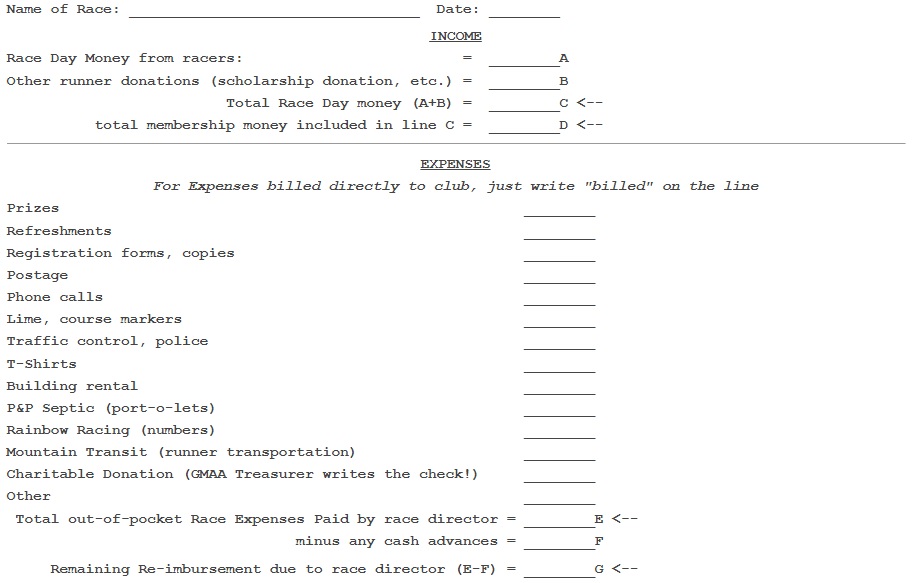
Note: The race director should give all race day money (line C) to the treasurer within a week after the race date. The treasurer will write a check to the director to reimburse any out-of-pocket expenses. The treasurer will construct a profit/loss statement based on this form, expenses billed directly to the club, and pre-registration money.
Please complete and return to Harry Curth [ or has_phone–> treasurer@gmaa.net]. The treasurer can answer any reimbursement questions and provide cash advances.
Race Kit Inventory
Download current form here.